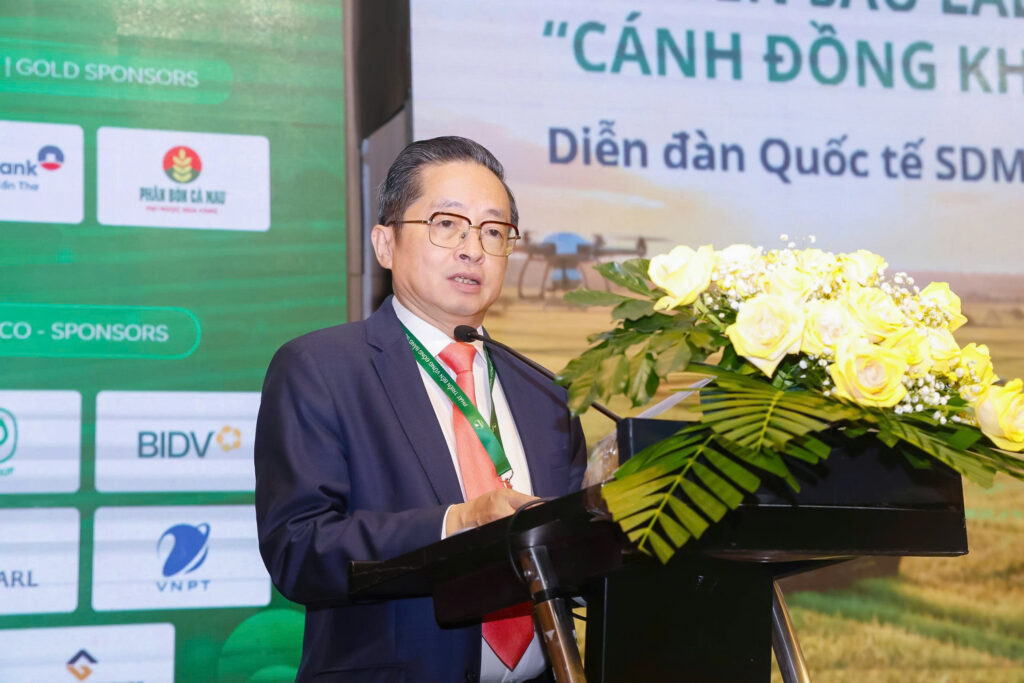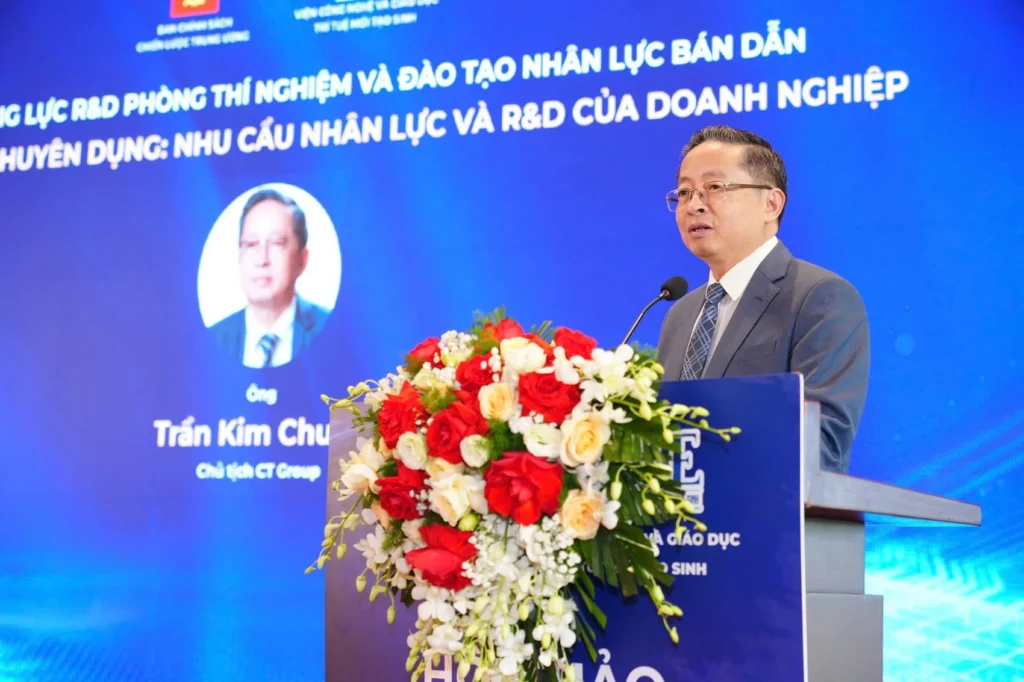



At the 3rd SDMD International Symposium held in Can Tho on the morning of November 27, Mr. Tran Kim Chung, Chairman of CT Group Hi-Tech, presented a series of technology-driven proposals aimed at enhancing the value of agricultural production and strengthening linkages among economic sectors across the Mekong Delta.
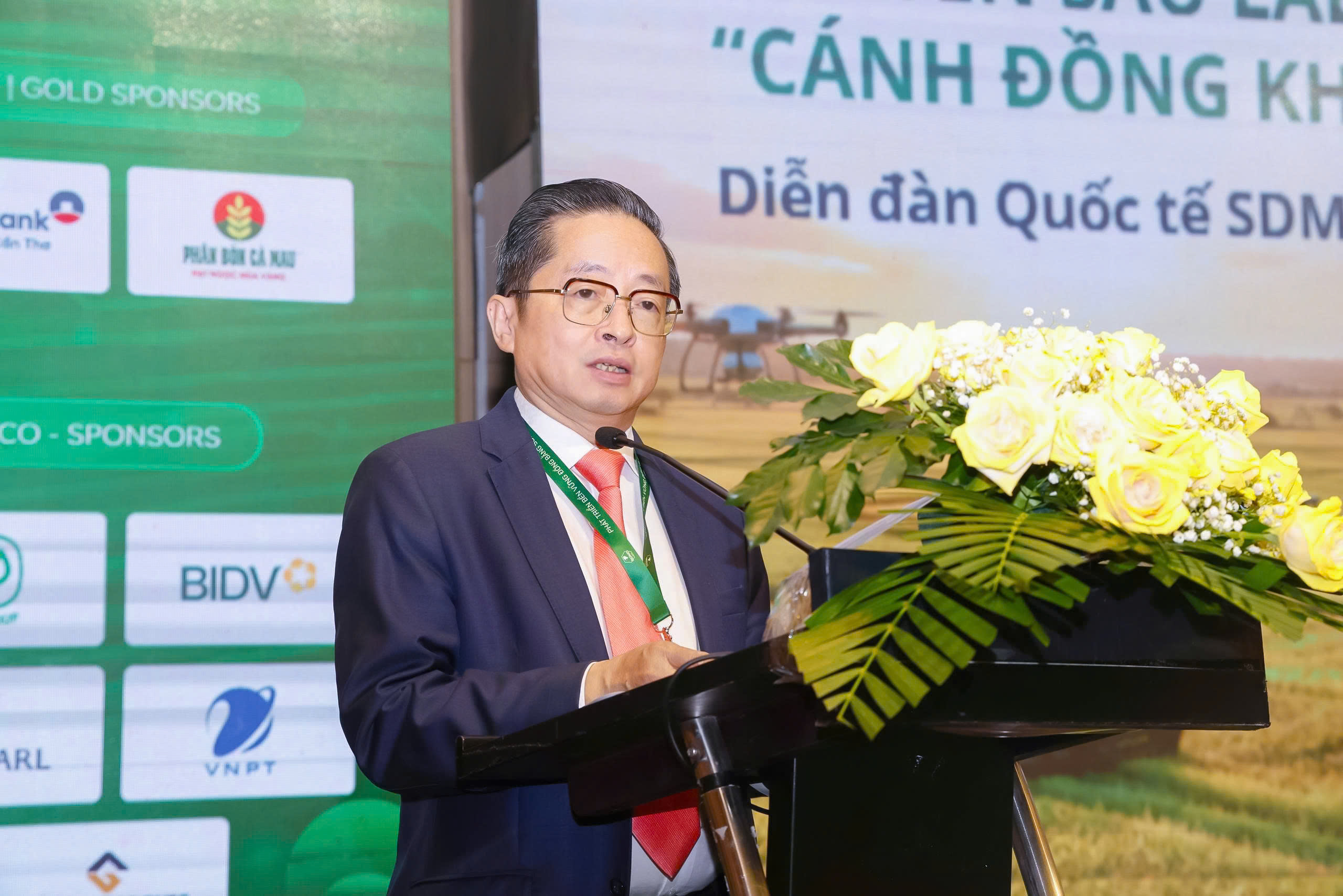
Mr. Tran Kim Chung, Chairman of CT Group Hi-Tech, proposes the development of “unmanned fields” in the Mekong Delta. Photo: Chinhphu.vn/Le Son
Toward ‘Unmanned Fields’
One of CT Group Hi-Tech’s key proposals is a precision agriculture model aimed at developing what it calls “unmanned fields.”
According to Mr. Tran Kim Chung, Chairman of CT Group Hi-Tech, the company is designing a pilot model for a 20-hectare rice-growing area in An Giang, with plans to collaborate with Loc Troi Group, the Cuu Long Delta Rice Research Institute, and technology units within CT Group Hi-Tech.
The proposed model will integrate Unmanned Aerial Vehicles (UAVs), autonomous robots, sensors, Artificial Intelligence (AI), biotechnology, and Digital Twin technology to monitor, analyze, and support the management of farming operations.
UAVs and sensor systems will collect data on crop conditions, soil, water, pests, and diseases. Based on these data, AI will help determine irrigation requirements, fertilizer application, pest and disease control measures, and optimal harvesting times.
Autonomous equipment will gradually take over suitable farming tasks under human supervision. Farmers will progressively shift from directly performing fieldwork to monitoring, operating, and controlling the system through technology platforms.
To enable farmers to access these technologies at reasonable costs without having to invest directly in UAVs, robots, or sensor systems, CT Group Hi-Tech proposes developing a network of agricultural technology service providers and technology cooperatives.
Service providers would invest in equipment, deploy technical teams, and handle operations and maintenance. Cooperatives would aggregate demand, coordinate farming areas, and connect farming households. Farmers could then register and pay for services based on acreage, specific farming operations, or crop seasons.
Under this model, a single UAV or robotic system could serve hundreds of farming households within the same production area. Services could include field surveying, seeding, precision spraying, water management, pest and disease monitoring, and agricultural data collection.
CT Group Hi-Tech aims to connect this initiative with the project to develop one million hectares of high-quality, low-emission rice in the Mekong Delta. Following the pilot phase and effectiveness assessment, the company plans to standardize the model and gradually scale it across suitable agricultural production areas.
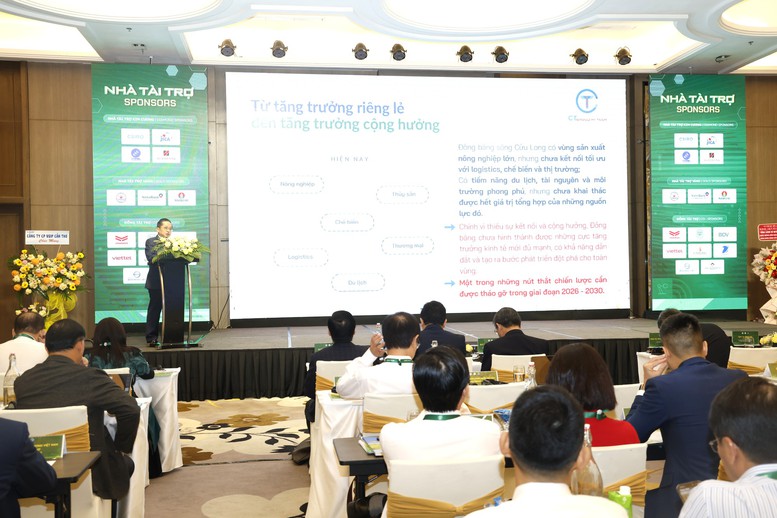
SDMD 2026 discusses technological solutions to advance sustainable development in the Mekong Delta toward 2045. Photo: Chinhphu.vn/Le Son
Targeting a 10–15% Increase in Agricultural Product Value
CT Group Hi-Tech also proposes developing an automated traceability system to enhance the commercial value of agricultural products from the Mekong Delta.
Supported by UAVs, robots, sensors, and AI, the system would record data throughout the production chain, covering seed origin, soil, water, fertilizers, cultivation, harvesting, preliminary processing, storage, and transportation.
Each batch of agricultural products would have its own digital profile and unique identification code. By scanning a QR code, consumers could access production history, cultivation data, quality testing results, and relevant certifications.
AI is proposed to support data analysis, cross-checking, and anomaly detection. Independent testing and verification results would serve as the basis for validating the reliability of traceability information.
For the pilot model, CT Group Hi-Tech is targeting a 10–15% increase in selling prices for products that fully meet traceability and quality verification requirements. The feasibility of this target will depend on product quality, the verifiability of the information provided, and market acceptance.
According to Mr. Chung, data on harvesting schedules and output volumes could also help connect agricultural production with cold storage facilities, transportation providers, processing plants, and market demand. This would enable better planning of transportation capacity, storage capacity, processing capacity, and product distribution.
CT Group Hi-Tech proposes further research in this area to help reduce post-harvest losses, shorten waiting times, and lower logistics costs.
The company also proposes applying technology to the measurement, monitoring, and verification of emissions in support of the green economy and carbon economy.
According to Mr. Chung, verified emissions reductions, when assessed in accordance with appropriate methodologies and standards, could generate economic value through green finance mechanisms and carbon markets. Benefit-sharing mechanisms should be transparent to ensure that farmers, cooperatives, and local communities can directly benefit.
Developing the Low-Altitude Economy in Can Tho
CT Group Hi-Tech identifies the Low-Altitude Economy (LAE) as a strategic development direction capable of creating new industries, businesses, and services for the Mekong Delta.
The Low-Altitude Economy extends far beyond UAV applications alone. It can support agricultural production, logistics, medical transportation, environmental monitoring, natural resource management, and disaster prevention and response.
Given the Mekong Delta’s extensive network of rivers and waterways, CT Group Hi-Tech is particularly interested in exploring the integration of UAV operations with inland waterway transport.
At the request of Can Tho City, CT Group Hi-Tech is working with relevant stakeholders to study models, solutions, and a development roadmap for the city’s Low-Altitude Economy.
The company has also proposed cooperation with Can Tho University to strengthen research, testing, training, and technical service capabilities, while gradually building a high-tech ecosystem in the city.
Under the proposed roadmap, the 2026–2027 period will focus on establishing foundational capabilities and implementing pilot programs. From 2028 to 2029, effective models would be evaluated, standardized, commercialized, and scaled up. By 2030, the company aims to contribute to the formation of new economic growth engines.
Mr. Chung emphasized that the effectiveness of these programs should be assessed through specific indicators, including reductions in production and logistics costs, productivity, quality, added value, resource-use efficiency, improvements in local incomes, and the number of new businesses and jobs created.
The Chairman of CT Group Hi-Tech concluded with the message: “The fields of the future may no longer bear human footprints, but they must unmistakably bear the imprint of Vietnamese intelligence.”
Source: Government News
________________________
Follow CT Group Hi-Tech on Facebook for the latest updates and news!