


From a research framework of 612 Low Altitude Economy (LAE) models to an agricultural Digital Twin and technology centers in Can Tho, CT Group Hi-Tech proposes a new development direction for the Mekong Delta. The company is ready to initiate several programs as early as late 2026 if the necessary consent and approvals are obtained in accordance with regulations.
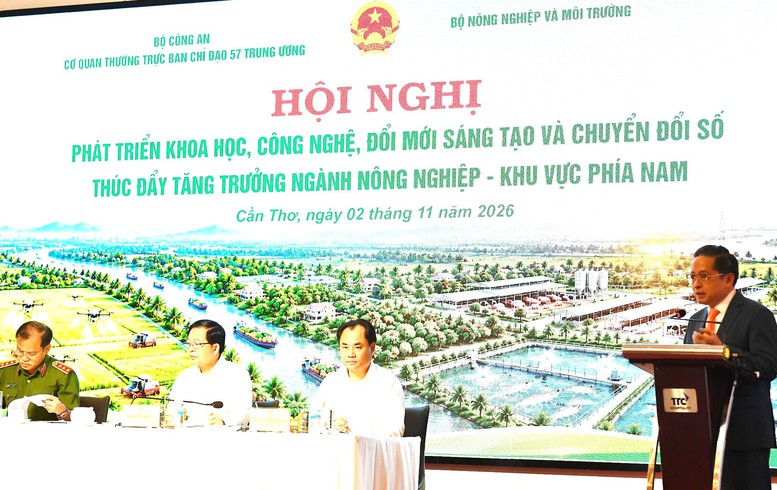
The conference in Can Tho focused on identifying new growth drivers for agriculture in Southern Vietnam through science, technology, innovation, and digital transformation. – Photo: Chinhphu.vn/Le Son
On November 2, at the Conference on the Development of Science, Technology, Innovation and Digital Transformation to Promote Agricultural Growth in Southern Vietnam, organized by the Ministry of Agriculture and Environment and the Ministry of Public Security in Can Tho, Mr. Tran Kim Chung, Chairman of CT Group Hi-Tech, presented proposals for applying technology to restructure the growth model of the Mekong Delta.
According to Mr. Tran Kim Chung, technology should not only aim to increase productivity and reduce costs but also open up new economic spaces, industries, and sources of revenue. Facing pressures from saltwater intrusion, land subsidence, freshwater shortages, climate change, and international markets, the Mekong Delta needs to shift from applying technology to individual projects toward using technology to redesign the economic development space of the entire region.
Digital Twin: Testing Options in a Digital Environment Before Investment
One initiative CT Group Hi-Tech is pursuing is the development of an Agricultural Digital Twin for the Mekong Delta, based on the 15-Layer National Digital Twin technology platform, abbreviated as NDT15. Rather than merely digitizing land maps, the company aims to develop a model capable of simulation, forecasting, and supporting strategic planning for the entire region.
Under the proposal, data on topography, soil characteristics, water resources, salinity, climate, hydrology, transportation, population, crops, livestock, and supply chains would be integrated and analyzed using Artificial Intelligence (AI). This would enable relevant authorities to compare options for changing rice varieties, changing crops, intercropping, or developing rice–shrimp and rice–fish farming models.
For example, the system is expected to support assessments of changes in productivity, costs, water demand, emissions, and economic efficiency when different production options are selected. Scenarios involving saltwater intrusion, drought, and flooding could also be simulated to support adaptation planning.
Mr. Tran Kim Chung believes that the significance of the Digital Twin lies in its ability to help management authorities test multiple scenarios in a digital environment before deciding on major investments in practice.
612 Low Altitude Economy Models: Not to Be Implemented Simultaneously
A notable point in the presentation was the research framework of 612 new industry and application models within the Low Altitude Economy (LAE), which CT Group Hi-Tech stated it had developed. The scope of research extends beyond agriculture to include logistics, transportation, environmental monitoring, irrigation, forestry, fisheries, search and rescue, and public services.
The company emphasized that it does not advocate implementing all 612 models simultaneously. Local authorities need to select applications that align with their respective advantages and resources.
In specialized rice-growing areas, Unmanned Aerial Vehicles (UAVs) could support precision agriculture, crop monitoring, and the transportation of agricultural supplies. In aquaculture areas, research focuses on environmental monitoring, monitoring of aquaculture areas, and logistics support. Areas with extensive river and canal networks could consider UAV-based transportation, while mangrove forest areas could apply UAV technology combined with AI to monitor natural resources and biodiversity.
According to the Chairman of CT Group Hi-Tech, each model must be quantified in terms of market size, investment capital, operating costs, new jobs, productivity, and added value. CT Group Hi-Tech seeks to collaborate on developing a comprehensive Low Altitude Economy master plan for the Mekong Delta. However, the implementation of each model will still require research and feasibility assessments.
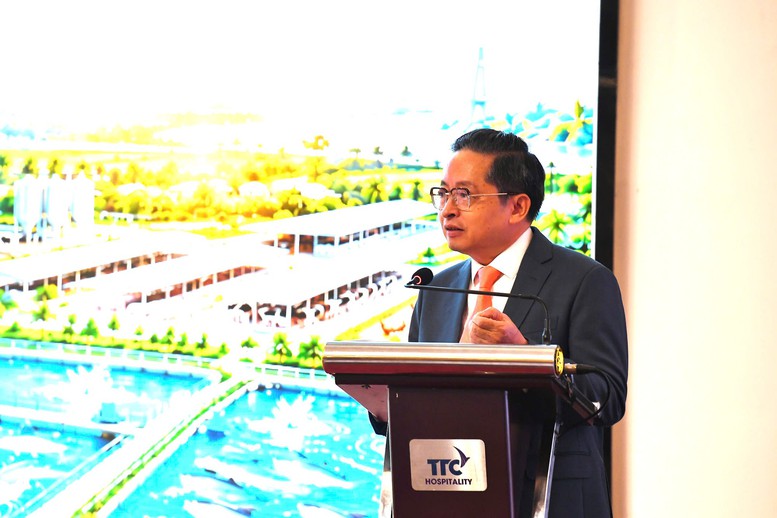
CT Group Hi-Tech Chairman Tran Kim Chung proposes research into 612 Low Altitude Economy (LAE) models, opening up a new direction for growth in the Mekong Delta. – Photo: Chinhphu.vn/Le Son
8 Technology Programs, with Multiple Proposals Located in Can Tho
Notably, Mr. Tran Kim Chung stated that CT Group Hi-Tech is ready to move forward with initiating several programs as early as November and December 2026, subject to approval in principle and other necessary approvals from local authorities. These proposals have not yet been approved as projects.
The first two programs involve establishing an Innovation Center in Can Tho and collaborating with Can Tho University to complete the development of the Agricultural UAV and Robotics Research Center. The Innovation Center is expected to connect scientists, businesses, universities, cooperatives, and investors to develop products with commercialization potential. Research into UAVs and robotics includes precision farming, harvesting, crop monitoring, and automation, moving toward unmanned field models.
The third program involves studying the establishment of a Mekong Delta Low Altitude Economy Research and Development Center, the development of appropriate operational corridors, a service ecosystem, and controlled pilot programs. The company emphasized the need to comply with flight safety, security, airspace management, and legal regulations.
The next two programs focus on digital infrastructure: pursuing an AI Factory in Can Tho to provide computing capabilities for specialized applications, and studying investment in a Data Center to support AI, Digital Twins, the Low Altitude Economy, and digital transformation.
CT Group Hi-Tech also proposed studying the development of a high-tech park with an estimated area of 200–300 hectares, focusing on UAVs, robotics, AI, semiconductors, biotechnology, and new materials. Another program aims to develop high-tech agricultural belts linked to urban areas, railway-oriented development, logistics centers, cold storage facilities, and deep processing, rather than developing isolated production areas.
The eighth program focuses on green agriculture, emissions reduction, and carbon credits. The company aims to use UAVs, AI, sensors, and Digital Twins to support the measurement, reporting, and verification of emissions reduction results in rice-growing areas, forests, and wetland ecosystems.
Regional Linkages, Controlled Testing, and Benefits for Farmers
According to Mr. Tran Kim Chung, the eight groups of programs need to be connected into an ecosystem: Digital Twins support planning, the AI Factory provides computing capabilities, data centers provide infrastructure, research centers develop solutions, while the high-tech park and agricultural areas serve as locations for production, application, and commercialization.
According to the speech, the technology centers are not separate projects. The ability to connect research, data, production, and markets is an issue that needs to be considered when making investment decisions.
For implementation, CT Group Hi-Tech proposed an interregional coordination mechanism to address issues relating to water resources, climate, logistics, and the Low Altitude Economy; create a controlled testing environment for new technologies such as UAVs, autonomous robots, and AI; and strengthen cooperation among the State, scientists, businesses, and farmers.
Under this cooperation model, the State provides direction and creates an enabling environment; scientists contribute knowledge; businesses invest, organize implementation, and commercialize solutions; while farmers participate directly and benefit from the outcomes. CT Group Hi-Tech stated that it is ready to mobilize its research, technological, and financial capabilities, along with its network of international partners, to work with local authorities to realize these objectives when all necessary conditions are met.
The final message emphasized by the Chairman of CT Group Hi-Tech was that technology must help farmers reduce production costs, improve product quality, and increase their real income.
Source: Báo Chính phủ
________________________
Follow CT Group Hi-Tech on Facebook for the latest updates and news!